

By Mohamed Elrashid and Scott Eastman
Nvidia announced Jensen Huang’s resignation as president and CEO on November 12. When we began forecasting his future four days earlier, Huang had acknowledged infidelity following New York Times reporting about his relationship with an executive at Megaspeed, an Nvidia customer. The Times reported that US officials had identified her as a Chinese intelligence asset. Nvidia’s board had announced an investigation and expressed confidence in Huang and his leadership team.
Our first forecast put the probability that Huang would be forced to leave as CEO by June 30, 2027 at 20.9%, which we describe as unlikely. Following reports of a second affair with a subordinate and board preparations to remove him, our final forecast before the announcement had risen to 87.4%, or very likely.
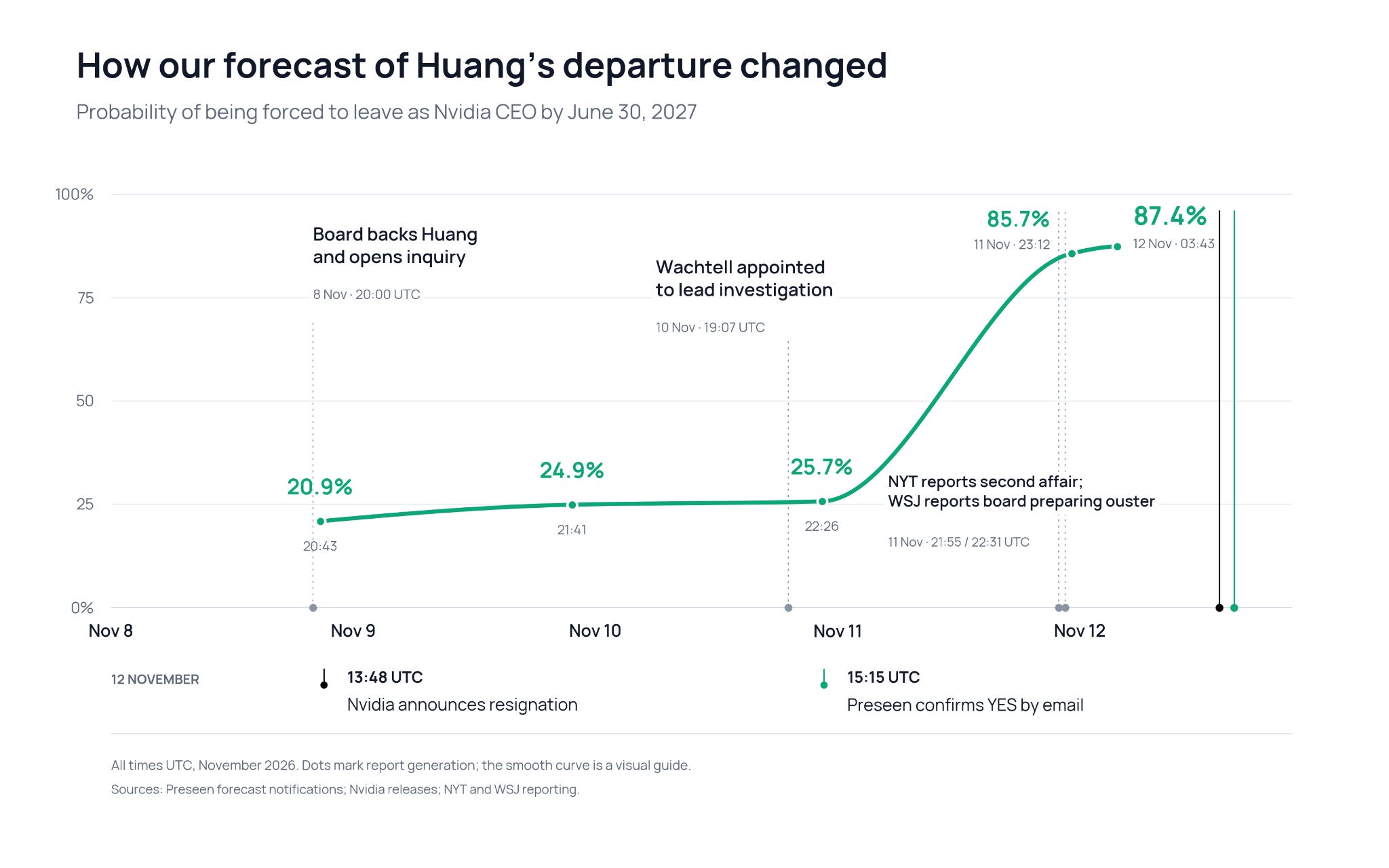
We’re now looking at what comes next for Nvidia and the AI companies that depend on its chips and financial support. Three questions: Who will replace Huang? Will Nvidia scale back that support? And how will chip export controls change?
1. Who will replace Huang?
Finding Huang’s successor could take a while. We think it is likely, at 73.3%, that Nvidia reaches January 31, 2027 without announcing a permanent CEO, and put the chance of no permanent appointment being announced by June 30 at 21.9%.
For some context, Intel announced Lip-Bu Tan’s appointment 100 days after announcing Pat Gelsinger’s departure. Our January deadline gives Nvidia 80 days from its announcement of Huang’s resignation; June gives it 230. Nvidia’s board is considering internal and external candidates, and its initial announcement gave no timetable for completing the search. As our timing forecast explains:
Confidence in Kress and the existing leadership team supports an internal appointment, but also gives directors time to search carefully.
Among the candidates, Colette Kress leads our forecast at 22.6%, followed by Ian Buck at 17.7%. There is considerable uncertainty here: Kress becoming permanent CEO and nobody being named by the end of June receive almost the same probability. We put much less weight on Lisa Su or Hock Tan being named by that deadline, at 0.5% and 0.1%, respectively.
These candidate probabilities are from our November 13 forecast, generated at 11:55 UTC, before the Financial Times reported that Nvidia had approached Rene Haas. We’ll update the succession forecast as new information comes in, and encourage you to follow along.
Kress is serving as both interim CEO and CFO. We’re interested in how much of her job will involve steadying the ship, and how willing she and the board will be to make big bets while the search is underway.
2. Will Nvidia scale back its financial support?
Nvidia invests in its customers and makes commitments to buy otherwise-unsold computing capacity. How much of that will continue under its new leadership?
For CoreWeave, we think a cut of at least 10% in Nvidia’s remaining purchase obligations taking effect by June 30, 2027 is very unlikely, at 9.2%. The drivers here include contractual constraints, the value of that protection to CoreWeave and Nvidia’s own interest in avoiding disruption to a major partner and customer.
Looking a bit further forward, we forecast a median of $14.25 billion in cash equity purchases in the first half of FY2028, which would be a substantial reduction from the $42.4 billion Nvidia spent in the first half of FY2027. But for this forecast, the timing of a few large payments could itself materially shift the total, including payments against commitments Nvidia has already made.
For publicly quantifiable new commitments between November 13, 2026 and June 30, 2027, our medians are $3.75 billion in equity investments in independent AI developers and GPU-cloud providers and $2.25 billion in capacity-purchase backstops. In these cases, uncertainty is quite wide: for both, the middle 80% of our forecasts stretches from below $1 billion into the tens of billions.
There has been reporting from Reuters that Kress and her team pushed back on large financing deals. As our backstop forecast puts it:
Her record supports tighter selection and sizing more clearly than abandonment.
3. How will export controls change?
We think the US could, over the coming months, maintain a pathway for some chip sales to China while adding restrictions on rented access to compute elsewhere.
We think it is likely, at 72.6%, that eligible direct exports of H200 accelerators to mainland China remain subject to case-by-case license review on June 30, 2027. This would maintain broad discretion for the US government to approve or reject particular applications and tighten screening and conditions within that same review category.
At the same time, we’re putting a 62.9% probability on new US licensing requirements or prohibitions taking effect by June 30 for mainland China-headquartered companies or their subsidiaries renting advanced Nvidia computing capacity outside mainland China, Hong Kong and Macau. For this forecast, we’re concerned with additional legal restrictions that could affect only some providers, destinations or customer classes. There is still uncertainty about the eventual breadth of these restrictions and their effect on computing use.
For newer chips, we see almost no chance, at 3.4%, of a new US authorization for commercial exports of standard B200 or B300 accelerators to mainland China becoming operative and publicly confirmed by the end of January 2027, even for a single commercial customer.
These outcomes could all be true. We could see H200 licensing stay alongside tighter controls on overseas computing access and continued limits on standard Blackwell exports.
NOTE: The succession, financing and export-control forecast reports cited above were generated between 11:22 and 12:31 UTC on November 13, 2026. The linked questions contain the full resolution criteria and reasoning, alongside any subsequent forecasts. The commitment and contract-change forecasts rely on public disclosures. These forecasts do not isolate the effect of Huang’s departure from other changes affecting the company.